
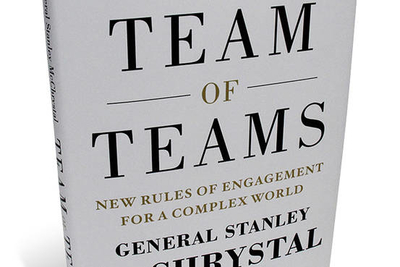
by Gen. Stanley McChrystal, Chris Fussell
Where did I find this?
Gen. McChrystal was a guest on the Tim Ferriss show, who came across in a way which made me want to learn more about his book.
Should you pick this up?
7.5/10
I thought that this book was well worth the read, and got through it quickly.
Review
In their book Team of Teams, Gen. Stanley McChrystal and his aide-de-camp Chris Fussell detail how during one of the most challenging times in modern US military history they were able to transform the Joint Special Operations Task Force (JSOC) to achieve key objectives in the conflict in Iraq. Interwoven throughout the book are personal experiences gleaned during the war against Al-Qaida in Iraq (AQI) and the leadership lessons that this fight inspired. In an engaging style, the book drives home a useful blend of practical and theoretical knowledge. Having read a number of other books on organizational management theory and leadership methods, the concepts presented are not novel, however, the combined application of these techniques under the stresses of the modern battlefield redefine “building the bridge while crossing it”. Along the way the reader is provided with a rare view inside of the most storied Special Operations Forces (SOF) unit in existence today.
The discussions found in the various chapters of the book are wide-ranging but relevant to leading in diverse organizations including our own here in corporate America. Indeed, there were a number of key topics covered which I felt resonated with me personally in research such as the critical differences between complicated and complex problems and the observation that increasing available information does not necessarily improve predictive power or enhance decision making.
Much of the content of the book is reflective and represents a diverse and authoritative treatment of management analysis principles, which I had not expected from the background of the authors. Indeed, this is exemplified by their thoughtful dissection of Frederick Taylor’s “The Principles of Scientific Management.” Taylor’s principles were derived from his own efforts to streamline the construction of hydraulic machinery during the industrial revolution. Foreshadowing the widespread adoption of the assembly line, Taylor articulated a focus on ensuring that managers focus only on efficiency, stating that “an effective enterprise is created by commitment to efficiency, and that the role of the manager is to break things apart and plan ‘the one best way’“. These practices spread like wildfire through historically artisanal professions and, despite repeated attacks on his treatment of individual workers, Taylor’s influence is still seen today in modern concepts of business management and corporate efficiency.
After setting the stage with historical context the authors then set about putting forward their own interpretation of today’s world, which calls for a fundamentally different approach to management and leadership. Referring to diverse source material such as Hayek’s “The Theory of Complex Phenomena” as well as examples drawn from large scale ecological interventions and “Big Data” analyses, the authors illustrate with surprising clarity the complexity of the world we live in today.
McChrystal and his team then go on to detail an approach to management that is built upon their experiences in Iraq in addition to the collated experiences of other highly effective teams throughout history. In response to what they see an increasingly complex world, McChrystal and his team advocate an approach termed “Empowered execution”. Drawn from lessons learned in war, they condense their experiences combating AQI into a series of principles that complement and support this new approach to management and leadership – principles that any leader wishing to advance their organization may read, internalize, and implement. Gen. McChrystal explains that as a leader in a team of teams, one must act more like a gardener tending a crop than as a commander in the traditional sense. He argues that by resisting the urge to intervene and instruct, instead letting others closer to the situation make decisions, leads to a more agile and efficient organization.
In essence the approach advocated through the book can be boiled down to one of top down transparency and extreme ownership. To explain these concepts the authors take the reader on a behind the scenes journey through the evolution of the Task Force, from initial failings and casualties to the culmination of the war on AQI and the triumphs of the newly empowered JSOC team. By changing their culture, structure, and habits to allow the larger corporate command to become as agile and capable as its elusive enemy, McChrystal has created a model which facilitated a complete turnaround not only for JSOC in Iraq, but also in the diverse businesses served in his current career as a corporate consultant.

 Think Live Grow